The MCAT is an extremely rigorous and comprehensive exam measuring a candidate’s understanding and skill across the core scientific subjects that form the foundation of medical knowledge and practice. It is required as part of your application to medical school across the United States and Canada.
This review will cover the details of the exam, including what materials you will be assessed on, the number of questions, type of questions, scoring details, registration details, and more.
What is the MCAT?
The Medical College Admission Test is an examination that evaluates problem-solving skills, critical thinking ability, and knowledge of scientific concepts in individuals who wish to study medicine.
The overall goal of the assessment is to evaluate not only your knowledge of familiar subjects but to determine your ability to use critical reasoning skills and apply them to scientific subjects you may not know much about. As such, the examination is considered to be challenging by most people.
Questions and Time Limit
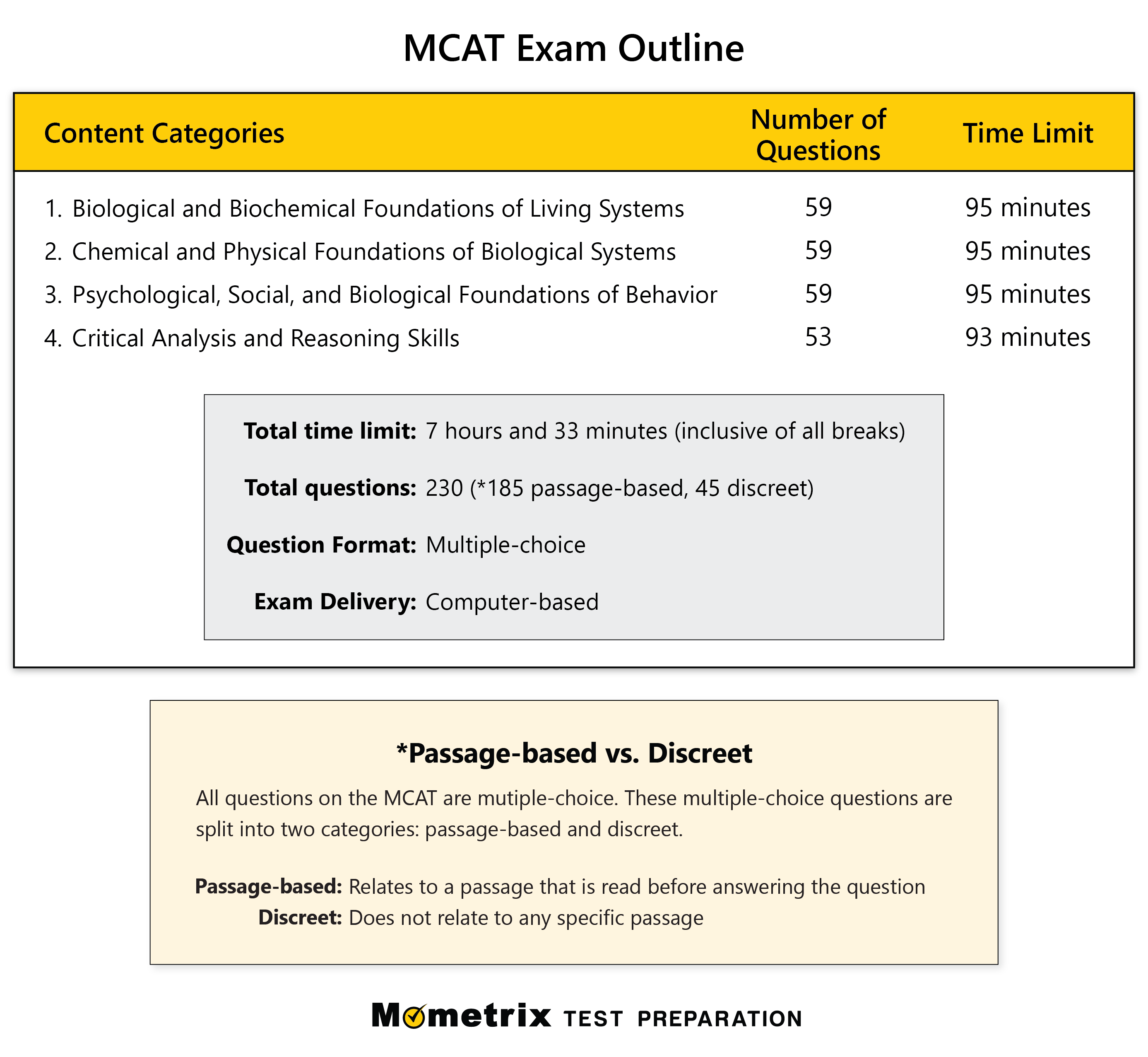
There are 230 questions in total on the exam, and you are allotted 7 hours and 33 minutes for the entire test. This time frame includes the breaks you are allowed during the examination. The actual time limit for just the answering of questions is 6 hours and 15 minutes.
You must take all sections of the exam in one sitting; if you need to retake the test, you will have to retake all sections again.
Check out Mometrix's MCAT Study Guide
Get practice questions, video tutorials, and detailed study lessons
Get Your Study Guide
MCAT Outline
The MCAT is divided into four sections, each covering different foundational concepts and skills.
Biological and Biochemical Foundations of Living Systems
The 59 questions in this section are devoted to assessing your knowledge and understanding of the basic processes that foster life. These processes include:
- Growth processes
- Reproduction processes
- Acquisition of energy
- How cells act independently and together to make each process work
- How the organs of the body can work both independently and together to make each process work
Within this section of the exam, the questions are divided into four categories.
- Biochemistry (25%)
- Biology (65%)
- General Chemistry (5%)
- Organic Chemistry (5%)
Chemical and Physical Foundations of Biological Systems
This section is devoted to assessing your knowledge and understanding of the basic physical sciences and biological sciences. These 59 questions are based on:
- Your understanding of the basic chemical and physical principles of the human body
- Your ability to apply the basic chemical and physical principles directly to living systems
Within this section of the exam, the questions are divided into five categories.
- Biochemistry (25%)
- General Chemistry (30%)
- Physics (25%)
- Organic Chemistry (15%)
- Biology (5%)
Psychological, Social, and Biological Foundations of Behavior
This section is devoted to assessing your knowledge and understanding of the statistical principles of behavioral and sociocultural determinants and how they affect health outcomes. Specifically, the 59 questions in this section are based on:
- Your ability to integrate psychology and biological bases of individual behaviors and relationships
- Your ability to integrate sociological and biological bases of individual behaviors and relationships
Within this section of the exam, the questions are divided into three categories.
- Psychology (65%)
- Sociology (30%)
- Biology (5%)
Critical Analysis and Reasoning Skills
This section is based on scenarios that are rooted in the disciplines of social sciences and humanities. These 53 questions are reliant less on your specific knowledge and more on your skills of critical thinking and reasoning.
The passages in this section cover the following:
- Ethical situations
- Philosophy
- Cultural studies
- Population statistics on health
Within this section of the exam, the questions are divided into three categories.
- Foundations of Comprehension (30%)
- Reasoning within the Text (30%)
- Reasoning beyond the Text (40%)
Details about the MCAT Questions
All MCAT questions are multiple-choice. These multiple-choice questions are split into two categories: passage-based questions and discrete questions.
Discreet questions are not related to a specific passage you read.
Passages will be provided for you to read, and then the questions after the passage allow you to apply your reasoning skills and your scientific knowledge to determine the best possible answer.
Registering for the MCAT
It is highly recommended that you register as far in advance as possible so you can get an opportunity to test in the location of your choice.
You also need to give yourself a minimum of three months to study and prepare for the examination. Most students planning to take the exam preparation for five or more months before their examination date.
Where to Register
Registering for the examination is done online at the AAMC website. You may also call 1-800-466-0450 to register over the phone. Whichever method you choose, you must have a valid government-issued ID and a credit or debit card in order to fully register.
Testing Locations
It is important when you are registering that you choose the testing location that works best for you. You can choose the testing site that is closest to where you live, or you can choose to drive to a location further away so you can test on a specific date.
You cannot change your testing location once you have chosen it, so write down the location and the time to help you remember.
Rescheduling Your Test Date
The only way to change the date of your examination is to register for a new test. You can not have two dates chosen for one registration.
When you reschedule to a different date you will be charged an additional amount.
- If the new test date is going to be within 30 days of you making the change you will be charged $200.
- If the new date will be a couple of months from the day you make the change you will be charged $100.
- If the date you are changing to is more than two months away the amount you will be charged will only be $50.
Planning and sticking to your original reservation will save you money.
Cancellations
If there is a reason that you cannot be at your chosen testing location on the test date you should cancel as soon as possible.
You might receive a full refund for your test fee if you cancel with plenty of time left. You may not get a refund or you may be given only a partial refund if you wait until the last minute to cancel.
Check out Mometrix's MCAT Flashcards
Get complex subjects broken down into easily understandable concepts
Get Your Flashcards
Test Day
All tests begin promptly at 8 am. You should arrive 30 minutes before this in order to check in and familiarize yourself with the testing center.
When you arrive, you will be assigned a locker to keep your food, snacks, and other belongings in while you are taking the test.
Items to Bring with You
- Any one of the following forms of valid identification, listed in order of preference:
- A state-issued identification card
- A state-issued drivers license
- A government-issued passport
- Nutritional food to eat during your lunch break or shorter breaks (lunch breaks last 30-minutes and shorter breaks are limited to 10-minutes)
- Medical necessities such as insulin pumps, inhalers, eyeglasses, braces, canes, and more
- Earplugs to help you concentrate (optional)
Items You should NOT bring with you
- Scratch paper (if needed, scratch paper will be provided for you upon asking)
- Cellphone
- Smartwatch
- Tablet
- Notebook or any written notes
The following are not acceptable forms of identification:
- Student identification card
- Credit card
- Library card
- Social security card
- Birth certificate
- Expired state-issued identification card
- Expired drivers license
Dress Code
You should be prepared to wear appropriate clothing that is NOT provocative or inappropriate to wear in a formal classroom environment.
Wear comfortable clothes that are not restrictive, or made from materials that make you itch.
MCAT Scores
While there is no set passing or failing grades, many educational facilities have their criteria for scores they will accept.
Passing Score
The MCAT does not have a set score that is determined to be passing. However, the majority of test-takers get a score of 504 or above.
The higher you score on this exam, the better your chances of being accepted into the medical school of your choice will be. Do your best to get as many correct answers on the exam as possible.
Receiving Your Test Score
It will take between 30 and 35 days before the scores are released. To view your scores sign in to your AAMC account and click on the button that says “Get Your Test Scores.”
Retaking the MCAT Exam
If you do receive a score that is lower than you want you can choose to retake the test and aim for a higher score.
You may take the test as many as three times in one year. You are limited to only 7 test attempts in your lifetime.
Retaking the test is difficult, but research has proven that on the second test attempt most test-takers score higher than they did on the first attempt!
How to Study for the MCAT
To help you optimize your study sessions, you should work with a comprehensive study guide like the Mometrix study guide. It includes a thorough review of the core concepts and vocabulary you will need to be familiar with. It also provides insightful tips for making educated guesses on questions you don’t know by using certain context clues and hints in the phrasing of the question and its possible answers.
For even better results, combine the study guide with a set of Mometrix flashcards. These flashcards were designed by experts who have done the research and honed in on the most important concepts and terms for the test. This way, you aren’t wasting precious study hours writing up hundreds of flashcards or making flashcards for things that you might not even need to know.
FAQs
Q
How long is the MCAT?
A
You are given 7 hours and 33 minutes for the entire test, which includes multiple breaks.
Q
What is a good MCAT score?
A
A good MCAT score to aim for is 510 or above. The average score is 504.
Q
How hard is the MCAT?
A
The MCAT is considered to be challenging by most people, as it covers a wide range of subjects along with technical aspects of some fields of study.
Q
How many times can you take the MCAT?
A
You may take the test up to three times in one year, but you are limited to only 7 test attempts in your lifetime.
Q
What does MCAT stand for?
A
MCAT stands for Medical College Admission Test.
Q
When do you take the MCAT?
A
There are several MCAT testing dates in 2024, which you can view by clicking below.
Q
How many questions are on the MCAT?
A
There are 230 questions on the MCAT in total.
Q
Is the periodic table provided on the MCAT?
A
Yes, a basic version of the periodic table of elements will be provided for you.

MCAT is a registered trademark of the Association of American Medical Colleges, which does not endorse Mometrix Academy or our methodology.